SCADA vs MES: What Each System Does Best
A line can be producing at rate while the plant still loses money through scrap, unplanned changeover time, incomplete genealogy, or operators working around unreliable screens. That is why the SCADA vs MES decision is not a software preference. It is an architecture decision that affects control, traceability, maintenance response, quality records, and the speed at which operations can act on production data.
Thank you for reading this post, don't forget to subscribe!SCADA and MES are often discussed as competing systems because both collect information from the shop floor and present it to users. In a properly engineered environment, they serve different layers of the operation. The right question is not which platform replaces the other. It is which operational gaps exist, where the source of truth should reside, and how the systems must exchange data without creating new failure points.
SCADA vs MES: The Core Difference
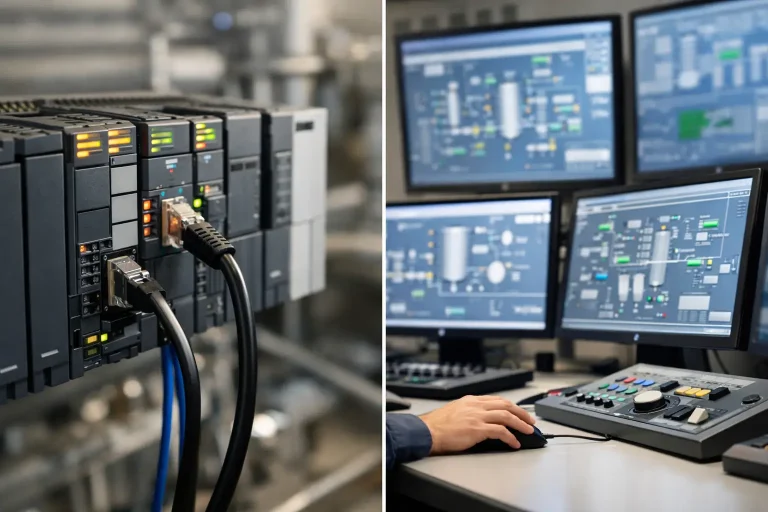
SCADA, or Supervisory Control and Data Acquisition, supervises and monitors industrial processes. It connects to PLCs, remote I/O, drives, analyzers, and other control devices to give operators real-time visibility and supervisory control. A SCADA application may display process graphics, trends, alarm states, equipment status, setpoints, and production counts. It is closely tied to the physical process and must perform reliably on the plant floor.
MES, or Manufacturing Execution System, manages and records the execution of production work. It sits above the control layer and turns production plans into actionable work instructions, electronic records, material tracking, quality checks, labor reporting, and performance metrics. MES answers questions that go beyond whether a pump is running or a tank is at temperature: Which order is running? Which lot was consumed? Was the required inspection completed? What caused the downtime? Can this finished product be traced back to its raw materials?
The distinction is useful, but the boundary is not always rigid. Some SCADA platforms offer batch, reporting, and production modules. Some MES platforms include operator interfaces and equipment connectivity. Features can overlap. System responsibility should not.
| Area | SCADA | MES | | — | — | — | | Primary purpose | Monitor and supervise physical processes | Execute, track, and document production work | | Primary users | Operators, maintenance, controls engineers | Production, quality, planners, supervisors | | Typical data | Tags, alarms, trends, states, setpoints | Orders, lots, recipes, quality records, downtime reasons | | Time sensitivity | Real-time or near-real-time process response | Transactional production events and operational records | | Typical integration | PLCs, RTUs, historians, control networks | ERP, quality systems, historians, warehouse and SCADA systems |
What SCADA Should Own
SCADA should be engineered around situational awareness and controlled response. On a packaging line, that may mean clear machine status, interlock indications, alarm priorities, fault guidance, rate trends, and controlled access to setpoints. In a process facility, it may mean tank levels, valve positions, loop status, alarm annunciation, batch phase visibility, and historical process trends.
A well-designed SCADA system improves operator response because it presents the right information at the right level of detail. That requires more than attractive graphics. Alarm rationalization, consistent navigation, tag naming, user-role security, communications diagnostics, and tested failure behavior are part of the design. If an HMI or SCADA screen masks a permissive, misrepresents a running state, or floods an operator with nuisance alarms, it creates operational and safety risk.
SCADA is also the appropriate place for supervisory commands where the underlying PLC logic enforces the required permissives and interlocks. It should not become a substitute for deterministic machine control. Critical control functions, protective logic, and safety functions belong in properly designed control and safety systems, not in a general-purpose supervisory application.
What MES Should Own
MES creates operational discipline around the work being performed. It can dispatch production orders, enforce the correct recipe or routing, verify material availability, require electronic signoffs, record in-process checks, and capture actual production consumption and output. For regulated or high-consequence manufacturing, these records may be central to release decisions, audit readiness, and root-cause investigations.
Consider a batch operation with multiple similar raw materials. SCADA can show the operator that a transfer pump is available and the receiving vessel is ready. MES can verify that the selected material is the approved lot for the active order, require barcode confirmation, prevent an out-of-sequence step, and record who performed the action. The systems support the same operation, but they manage different risks.
MES is particularly valuable when production performance is obscured by manual logs, spreadsheet-based schedules, paper travelers, disconnected quality records, or inconsistent downtime reporting. It provides context that raw tag data cannot supply on its own. A historian may show that a filler stopped 18 times. MES can classify the stops, associate them with the order and shift, and reveal whether the loss was caused by material starvation, changeover, mechanical failure, or quality holds.
Where Integration Creates Value
The strongest SCADA and MES architectures use defined interfaces rather than uncontrolled data sharing. SCADA provides trusted equipment states, process values, alarms, counters, and completed event signals. MES provides the production context: the active order, target quantity, approved material, required steps, and reporting requirements.
For example, MES may issue a production order and approved recipe version to the operational layer. SCADA and PLC logic execute the process within configured limits. As the run proceeds, SCADA returns production counts, process exceptions, equipment states, and completion status. MES records the electronic batch or production record and communicates confirmed production information to ERP.
This exchange requires clear ownership of each data element. If both systems can edit a recipe, reset counts, or determine an equipment state, discrepancies are likely. Define the system of record for recipes, material master data, work orders, quality status, and equipment status before selecting interfaces. Then document what happens when communications fail, a transaction is rejected, or an operator needs to place equipment in manual mode.
Integration design also needs to account for network segmentation, authentication, audit trails, data buffering, and recovery. A lost connection between MES and SCADA should not leave a production line in an unsafe state or force operators to bypass controls. Critical process control must remain available at the PLC and local control level. Production transactions can be queued and reconciled if the architecture supports it.
Safety and Compliance Are Separate Design Obligations
Neither SCADA nor MES is a safety system by default. A SCADA alarm may notify an operator of a high-pressure condition, but it is not the same as an independent protection layer designed to meet a required Safety Integrity Level. An MES instruction may require a pre-start inspection, but it does not replace safety PLC logic, emergency stop circuits, machine guarding, or validated interlocks.
Facilities operating under IEC 61511, OSHA requirements, customer standards, or internal EHS programs should assess these boundaries directly. Safety instrumented functions need defined requirements, verification, proof-test considerations, change control, and lifecycle documentation. The same principle applies to machine safety: safety functions must be designed and validated according to the applicable risk assessment and standards, independent of production reporting functions.
SCADA and MES can support compliance by providing alarm records, audit trails, electronic procedures, maintenance prompts, and evidence of completed checks. They should not be assigned protective responsibilities that their architecture, validation, or response time cannot support.
How to Decide What Your Plant Needs First
Start with the operational constraint, not a platform name. If operators lack reliable visibility into equipment condition, alarms are poorly managed, control screens are obsolete, or process data is unavailable, SCADA modernization may be the first priority. Stabilizing the control and supervisory layer often produces immediate gains in uptime, troubleshooting time, and process consistency.
If equipment data exists but the plant cannot accurately track work orders, lots, quality checks, changeovers, or OEE losses, MES may deliver greater value. This is common when production records remain paper-based or when ERP transactions are delayed until the end of a shift.
Many facilities need both, but not all at once. A phased program can begin with PLC and SCADA modernization, standardized tag structures, historian connectivity, and alarm management. That foundation makes later MES integration less expensive and more reliable. Conversely, a facility deploying MES may need targeted controls upgrades where older equipment cannot expose trustworthy run states, counts, fault codes, or material consumption data.
Before committing capital, assess the installed base, network architecture, data quality, operator workflows, safety requirements, and maintenance capability. SIS Automations approaches these projects as an integrated controls and operations problem, because a production system only performs as well as its weakest interface.
The useful next step is to map one high-value production flow from order release through finished-goods confirmation, including every manual handoff, alarm response, quality check, and data entry point. That map will show whether the immediate constraint is control visibility, execution discipline, or the integration gap between them.