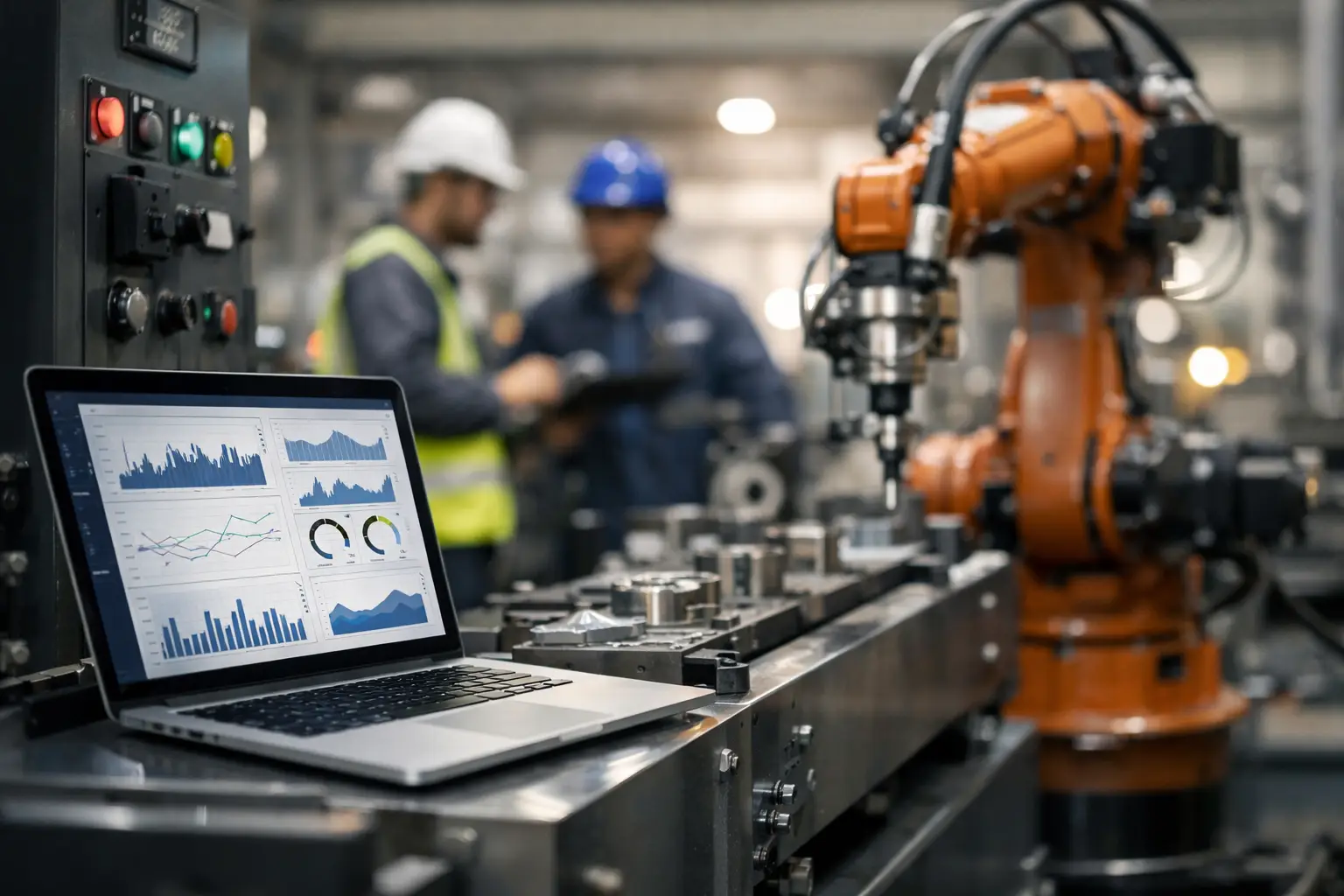
Data Logging for Manufacturing That Drives Uptime
A filler capper that stops twice per shift, a batch temperature that drifts only during the night run, or a recurring overload fault can look like unrelated maintenance events. Without a reliable record of what the machine, process, and operator conditions were doing before the event, the plant is left troubleshooting from memory. Data logging for manufacturing changes that equation by converting PLC, sensor, drive, and operator data into time-stamped evidence.
Thank you for reading this post, don't forget to subscribe!The goal is not to collect every available tag. It is to capture the right information at the right resolution, preserve it reliably, and present it in a form that supports action. When engineered correctly, logging supports root-cause analysis, quality traceability, OEE improvement, preventive maintenance, energy management, and compliance obligations. When engineered poorly, it creates expensive storage, slow reports, and a database full of signals no one trusts.
What Data Logging for Manufacturing Should Accomplish
Manufacturing data logging records process and equipment conditions over time. Those records may come from PLCs, safety controllers, SCADA systems, HMIs, variable frequency drives, vision systems, test stations, barcode readers, laboratory instruments, or utility meters. The practical value comes from correlating those signals with a production event: a rejected part, a line stop, a quality hold, an alarm, a batch release, or a safety trip.
For a packaging line, useful records might include conveyor speed, product count, reject count, photoeye status, servo faults, air pressure, line state, and operator-entered reason codes. For a thermal process, the priority may be temperature profiles, setpoints, burner status, valve position, batch identifiers, and alarm acknowledgments. A discrete assembly cell may need torque results, part genealogy, vision inspection outcomes, cycle time, and machine-state history.
This distinction matters because a historian is not automatically a performance system. A plant can have years of archived tags and still lack the context needed to explain why first-pass yield dropped on a specific shift. Data must be structured around operational questions, not simply around what is convenient to read from the controller.
Start With the Decisions the Plant Needs to Make
The first engineering step is defining the decisions that logged data must support. This keeps tag selection, storage design, reporting, and validation aligned with plant priorities.
A maintenance manager may need to identify whether repeated motor trips follow rising current, short cycling, low supply pressure, or a specific production recipe. A quality leader may need electronic records proving that every unit stayed within a defined process window. An operations manager may need accurate loss categorization to separate planned changeover time from starvation, blockage, fault recovery, and operator delay.
These use cases require different data models. A one-second sample rate may be sufficient for utility monitoring but miss a high-speed machine fault that develops and clears within milliseconds. Conversely, logging hundreds of high-frequency tags from every device can overload controllers, networks, and storage without improving decisions. Sampling intervals, event triggers, deadbands, and retention periods should be selected based on process dynamics and investigation requirements.
A practical design often combines periodic logging with event-based capture. Periodic samples establish normal operating behavior. Event records preserve the detailed conditions surrounding a fault, alarm, recipe change, safety event, or quality deviation. The combination provides both long-term trend visibility and diagnostic depth.
Build the Architecture From the Plant Floor Up
Reliable logging starts at the controls layer. PLC programs should expose clear, documented tags with consistent engineering units, scaling, state definitions, and alarm identifiers. If one machine reports line speed in feet per minute, another in hertz, and a third in raw encoder counts, plant-level analysis becomes unreliable before the data reaches SCADA or a historian.
Time synchronization is equally important. PLCs, HMIs, SCADA servers, historians, and test equipment need a common time source. A fault sequence cannot be reconstructed accurately when one device is several minutes ahead of another. In regulated or safety-sensitive applications, timestamp integrity, user attribution, audit trails, and record retention may carry additional requirements.
The communication path must also be designed for plant conditions. Network interruptions occur. Controllers restart. Servers are patched. A logging system should define how it handles buffered data, duplicate records, communication quality, missing samples, and recovery after an outage. Data quality indicators are not optional. Analysts need to know whether a value represents a valid measurement, a stale communication value, a substituted default, or an unavailable signal.
At the supervisory level, SCADA can provide real-time visualization, alarm handling, and operator interaction, while a historian or industrial database provides longer-term storage and retrieval. The right platform depends on existing infrastructure, tag volume, reporting needs, cybersecurity requirements, and whether the system supports a single machine, a production line, or multiple facilities. Modernization projects often need to bridge legacy PLCs and new equipment without disrupting production.
Make Context Part of Every Record
A trend of temperature, pressure, or motor current is useful. That same trend paired with batch number, product SKU, recipe revision, line state, operator action, and alarm history is far more valuable. Context is what turns raw machine data into manufacturing evidence.
Production states deserve particular attention. A machine that is powered but waiting for upstream material should not be counted the same way as a machine stopped by a fault. Standardized state models and reason codes improve OEE calculations and prevent arguments over why a line lost time. Reason codes should be limited, clearly defined, and governed by operations. If the list is too long or ambiguous, operators will select generic categories that defeat the purpose of the system.
For traceability, the logging design should connect process values to the unit, lot, pallet, or batch being produced. That may require integration with barcode systems, MES platforms, quality databases, or ERP records. The level of genealogy depends on the industry and risk profile. A consumer goods line may need lot-level traceability, while medical device, food, pharmaceutical, or automotive operations may require tighter controls over electronic records, revisions, and retention.
Use Logged Data to Reduce Repeat Failures
The best use of manufacturing data is not a monthly dashboard. It is a disciplined process for resolving recurring losses.
When a defect or downtime event occurs, engineering should review the event window rather than only the alarm that appeared on the HMI. Compare the affected cycle or batch with known-good production. Look for changes in process values, equipment states, recipe parameters, operator actions, utility conditions, and prior alarms. This approach can reveal issues such as a pressure regulator that sags during high demand, a temperature loop that oscillates after a recipe change, or a conveyor drive that draws abnormal current before jamming.
The resulting corrective action may be mechanical, procedural, electrical, or controls-related. Logging does not replace experienced technicians or process engineers. It gives them a defensible basis for prioritizing work and verifying whether the fix actually held.
Data can also support condition-based maintenance. Rising vibration, increasing motor current, longer cycle times, repeated valve retries, or growing temperature deviation may indicate degradation before a failure stops production. The threshold should be based on equipment behavior and process consequences, not an arbitrary dashboard color. Some assets justify continuous condition monitoring; others are better managed through periodic inspection and failure history.
Security, Safety, and Compliance Cannot Be Added Later
Connecting production systems to databases, reporting tools, or enterprise platforms expands the attack surface. Logging architecture should follow OT cybersecurity practices that separate control networks from business networks, restrict access by role, document data flows, and manage remote connectivity carefully. A reporting need should never create a path that compromises controller availability or safety functions.
Safety-related data requires similar discipline. A data historian can help investigate emergency stops, safety gate activity, bypass usage, trips, proof tests, and demand events. It does not replace the required design, validation, and lifecycle management of a safety function. For facilities operating under standards such as IEC 61511, records must support the site’s defined safety lifecycle and proof-test practices without creating confusion about the source of record.
Where electronic records affect quality or regulatory compliance, define ownership early. Determine who can change tags, scaling, alarm limits, recipes, report logic, and retention settings. Changes should be controlled, tested, documented, and commissioned like any other production-impacting controls modification.
A Practical Implementation Path
Most plants do not need a full rip-and-replace project to gain value. A focused pilot on one chronic loss area can establish standards for tags, naming, time synchronization, event capture, reporting, and user roles. Select a line or process with measurable pain: frequent unplanned downtime, high scrap, unresolved quality variation, or weak traceability.
Before deployment, verify field instrumentation and signal quality. Logging a bad transmitter more frequently does not improve process control. Review PLC scan impact, network capacity, server sizing, retention requirements, backup and recovery procedures, and operator workflow. Then commission the system under real production conditions, including communication loss and recovery scenarios.
SIS Automations approaches data logging as part of the controls architecture, not as an isolated reporting feature. The value comes from integrating PLC logic, SCADA visibility, historian design, machine states, alarms, and safety considerations into a system operators and engineers can rely on.
Start with one question your plant cannot answer confidently after a bad shift or a failed batch. Build the logging strategy around producing a trustworthy answer, then expand it where the evidence delivers measurable operational value.