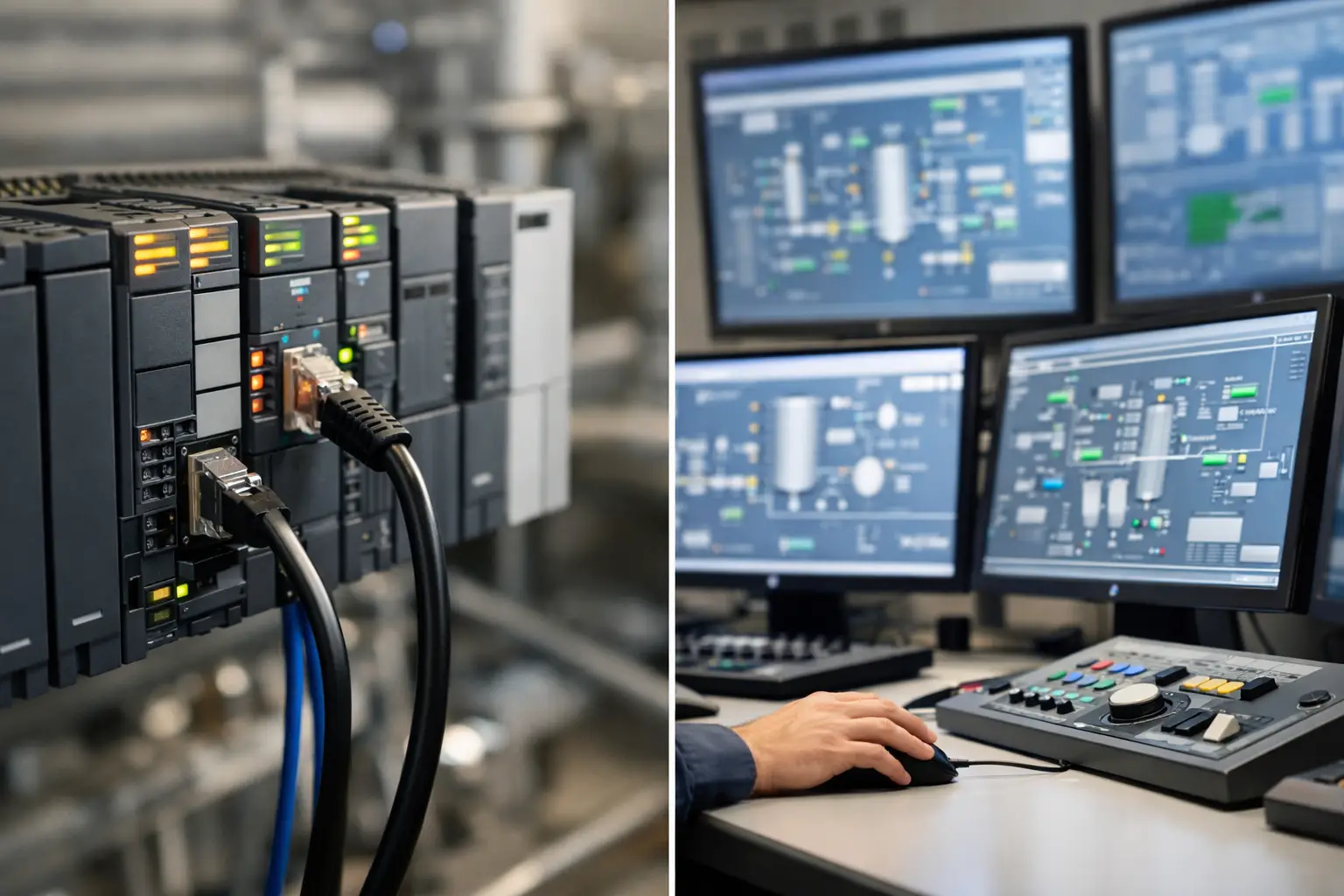
PLC vs DCS: Which Control System Fits?
When a plant is fighting nuisance trips, inconsistent batch performance, or a controls platform that has grown into a patchwork of add-ons, the plc vs dcs question stops being theoretical. It becomes a capital planning issue, an uptime issue, and in many facilities, a safety and compliance issue. The right answer depends less on which platform is “better” and more on what the process demands over the next ten to fifteen years.
Thank you for reading this post, don't forget to subscribe!For some operations, a PLC-centered architecture delivers exactly the speed, flexibility, and cost control they need. For others, especially continuous or highly integrated process environments, a DCS provides the level of coordination, operator context, alarm handling, and lifecycle management that keeps production stable. The mistake is forcing one architecture into a role it was not designed to handle.
PLC vs DCS: the real difference
At a high level, PLCs and DCS platforms both automate industrial processes. Both can read inputs, execute control logic, write outputs, communicate with field devices, and support visualization through HMI or SCADA layers. On paper, that overlap can make the choice look narrower than it really is.
The difference is architectural intent. A PLC was historically built for fast, deterministic machine and equipment control. It excels where discrete logic, sequencing, interlocks, motion, and high-speed response matter. A DCS was built for coordinated process control across a broader plant area, where hundreds or thousands of loops, operator situational awareness, alarm rationalization, historian integration, and consistent control strategy management all matter at the same time.
That distinction still holds, even though modern platforms have blurred the edges. Today, PLCs can handle process loops very well, and many DCS platforms can execute sophisticated logic. But the engineering workflow, system management model, and operational behavior are still different enough that architecture selection has real consequences.
Where PLCs make the most sense
PLCs are often the right fit for machine-centric and modular systems. Packaging lines, material handling systems, OEM skids, water booster packages, conveyor systems, and standalone process cells are common examples. In these cases, the controls problem is usually localized. The system needs to start, stop, sequence, interlock, fault clearly, and recover quickly.
A PLC-based design also makes sense when the plant needs flexibility. If equipment is being added in phases, if multiple vendors are supplying skids, or if the automation scope is tied to one production area rather than an entire process train, a PLC architecture can be easier to deploy and expand. Engineering teams are also often more familiar with PLC ecosystems, which affects supportability, troubleshooting speed, and spare parts strategy.
Cost is part of the conversation, but it should be handled carefully. A PLC may look less expensive upfront, especially on a smaller project. That does not always mean lower total cost. If the result is a collection of independent PLCs with inconsistent alarming, fragmented operator graphics, and custom integrations that become hard to maintain, the savings can disappear over time.
Where DCS platforms earn their value
A DCS is usually the stronger choice when process stability and plant-wide coordination matter more than localized machine control. Chemical processing, refining, pharmaceuticals, food and beverage batching, pulp and paper, and utilities often fall into this category. These environments depend on control strategies that are not just fast, but consistent, visible, and manageable across the operation.
The value of a DCS shows up in how the system is engineered and operated. Control modules, faceplates, alarms, trends, historian access, and operator navigation are typically more standardized. That consistency reduces operator burden, improves response during abnormal conditions, and makes changes easier to govern. For plants that run continuously or have high consequences for upset conditions, those are not convenience features. They are risk controls.
DCS platforms also tend to support process-oriented functions more naturally. Complex analog control, recipe or phase management, integrated alarm management, and coordinated plant-wide control strategies are generally easier to implement cleanly. When uptime depends on seeing interactions across units rather than just inside one panel, architecture matters.
PLC vs DCS for safety, compliance, and risk
This is where many decisions get oversimplified. Neither PLC nor DCS automatically solves a safety problem. Safety performance depends on proper hazard analysis, safety requirements specification, device selection, proof testing, separation, and lifecycle management. A poor design on an advanced platform is still a poor design.
That said, the control architecture does affect how safely and reliably the system can be operated. In facilities with Safety Instrumented Systems, burner management, emergency shutdown functions, or machine safety requirements, the basic process control system has to coexist with independent protection layers. The boundaries between control, alarm response, and safety action must be clear.
In a PLC-based environment, this often means separating standard control PLCs from safety PLCs and validating interlocks, shutdown logic, and field device behavior carefully. In a DCS environment, it means understanding which safety functions are integrated, which are independent, and how operator interfaces present critical information. Standards such as IEC 61511 raise the bar on lifecycle discipline regardless of platform.
For plants managing MOC, alarm floods, legacy logic, and undocumented bypasses, the best answer is rarely just a hardware swap. It is an engineering review of control narratives, cause-and-effect logic, alarm priorities, safety functions, and failure modes before architecture is selected.
Integration and lifecycle support matter more than specs
A common failure point in plc vs dcs evaluations is focusing too heavily on controller specifications while ignoring implementation realities. Processor speed, I/O density, and network performance matter, but they are not the whole picture. The real question is how the system will behave during expansion, troubleshooting, shift turnover, maintenance outages, and future modernization.
Think about integration first. Will the platform need to connect to drives, analyzers, VFDs, batch systems, historians, ERP layers, remote I/O, and third-party skids? Will maintenance teams have one consistent environment to support, or several? Can alarms, events, and trends be trusted across the operation, or are they assembled from multiple software layers with varying quality?
Then consider lifecycle support. Many plants are operating systems that were modified over years without standards, revision control, or clear documentation. In that environment, the best platform is the one that can be engineered cleanly, documented properly, commissioned safely, and supported long after startup. That is one reason modernization projects often start with an audit rather than a purchase order.
How to choose between PLC and DCS
The strongest selection process starts with the process, not the product. If most of the control challenge is discrete, equipment-based, or skid-oriented, a PLC architecture is often the practical choice. If the operation depends on coordinated analog control, plant-wide visibility, standardized operator interaction, and stable continuous processing, a DCS usually has the advantage.
Scale matters, but scale alone is not enough. A large packaging operation may still be best served by networked PLC systems. A smaller specialty chemical unit may justify a DCS because the control complexity and upset risk are high. The nature of the process is more important than the number of I/O points.
Internal resources should also shape the decision. If your maintenance and controls teams are deeply experienced with one environment, that has value. But familiarity should not override fit. A platform that feels easier on day one can become harder to live with if it does not support the process model, alarm philosophy, and operating discipline the plant actually needs.
A practical selection framework usually comes down to five questions. What type of process are you controlling? How much operator coordination is required across units? What are the consequences of upset, downtime, or poor visibility? How will safety systems interface with control systems? And what will the plant need to change over the next decade?
The gray area is where good engineering matters
Many facilities do not need a pure PLC or pure DCS answer. Hybrid architectures are common and often appropriate. A plant may use PLCs for packaged equipment and machine areas while relying on a DCS for unit operations and supervisory process control. In other cases, a PLC-based control layer combined with a strong SCADA and historian strategy can meet business and operational needs effectively.
The key is to avoid accidental architecture. Systems should be integrated by design, not by inheritance. That means consistent tag structures, defined network segmentation, cybersecurity planning, alarm philosophy, documented interlocks, tested fail states, and a clear separation between control and safety functions.
This is where an engineering partner with both controls and safety experience adds value. SIS Automations works with plants that are not just choosing software or hardware, but trying to reduce downtime, improve visibility, modernize safely, and meet compliance obligations without disrupting production more than necessary.
The better question is not whether PLC or DCS wins. It is which architecture gives your operators better control, your maintenance team better supportability, and your facility a safer, more reliable path forward.