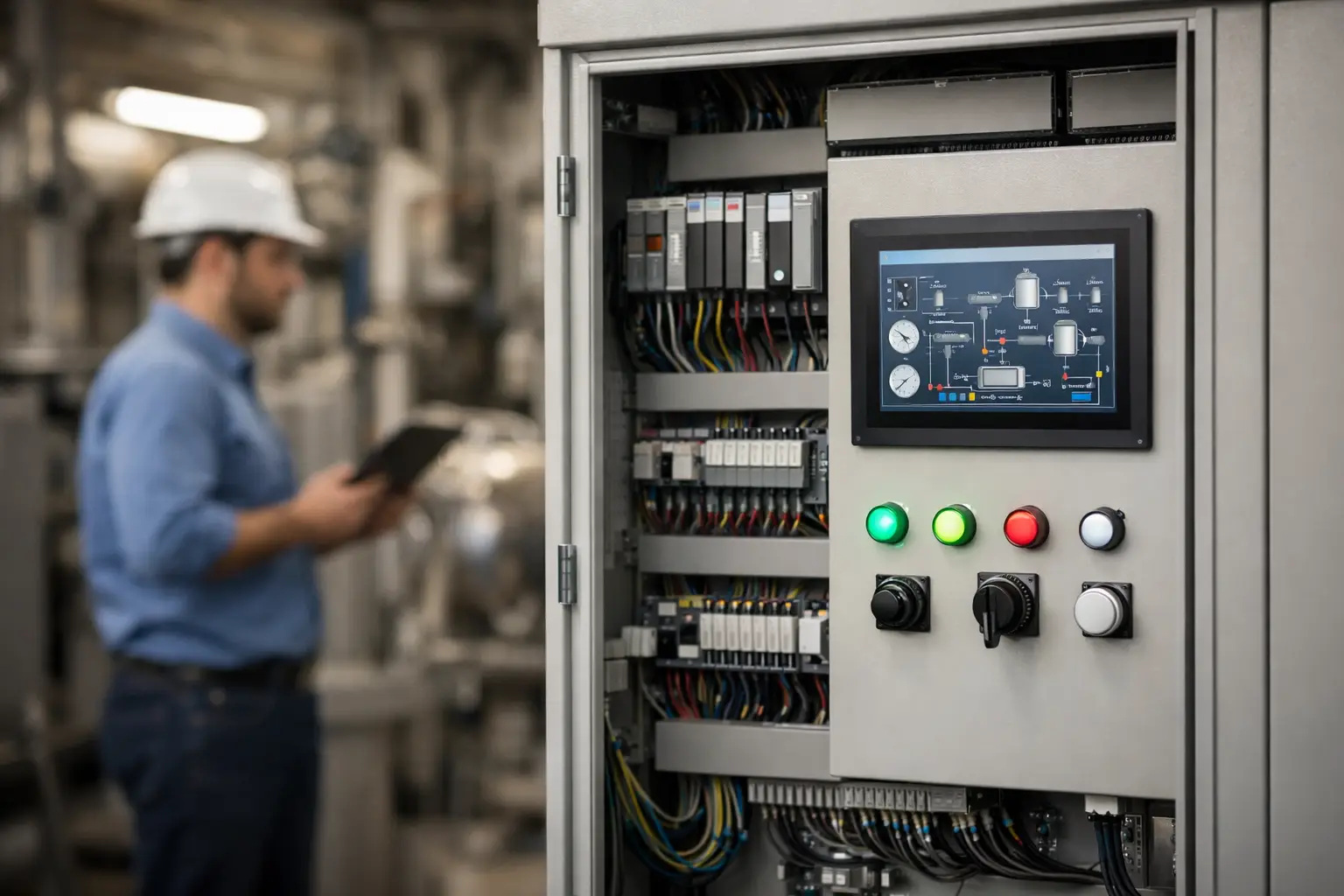
Control Panel Design for Reliable Operations
A control panel that looks organized on delivery can still become a source of nuisance trips, slow troubleshooting, heat-related failures, or compliance gaps once it hits the plant floor. That is why control panel design is not just a drafting exercise. It is a reliability, safety, and maintainability decision that affects uptime from day one.
Thank you for reading this post, don't forget to subscribe!In most facilities, the panel is where electrical power distribution, PLC control, networking, safety logic, and operator interface all converge. If those elements are not engineered as a system, small design shortcuts tend to show up later as larger operational problems. A cramped enclosure makes modifications harder. Poor thermal planning shortens component life. Weak segregation between power and signal wiring creates noise and intermittent faults. Inadequate documentation turns a 20-minute diagnosis into a four-hour outage.
What good control panel design actually has to solve
Good control panel design starts with the process, not the enclosure layout. Before component selection begins, the engineer needs to understand how the machine or process operates, what the failure modes are, what production criticality looks like, and which codes and standards apply. A packaging line, a chemical skid, and a water treatment system may all use PLCs, HMIs, drives, and remote I/O, but the design priorities are different.
For a high-speed manufacturing line, access for maintenance and fast replacement of failed components may drive the layout. In a hazardous or highly regulated process environment, the design may be shaped more heavily by electrical classification, safety integrity requirements, and documented proof of compliance. In an aging plant with legacy equipment, integration strategy matters just as much as the new hardware.
This is where many projects go off track. A panel can be built to match a bill of materials and still fail to support the operating environment. The right question is not whether every component fits. The right question is whether the complete panel supports safe operation, reliable control, future maintenance, and realistic plant conditions.
Control panel design and plant reliability
Reliability is often won or lost in details that are easy to overlook during procurement. Heat load is one example. Drives, power supplies, PLC racks, and network equipment all contribute to enclosure temperature. If thermal calculations are ignored or ventilation is treated as an afterthought, the result may be premature device failure, unstable operation, or shutdowns during seasonal temperature swings.
Power quality and circuit protection are another common issue. Panels need coordinated protection that isolates faults without taking down unrelated equipment. The incoming power design, branch circuit architecture, grounding strategy, and surge protection approach should reflect the criticality of the application. A single fault should not create a plant-wide event when a more selective design could have limited the impact.
Wiring practices matter just as much as component selection. Proper wire routing, ferruling, terminal identification, and segregation between power, control, analog, and communications circuits improve noise immunity and reduce troubleshooting time. In real production environments, maintainability is not a secondary concern. It directly affects mean time to repair and total downtime cost.
Documentation has a similar effect. Accurate schematics, panel layouts, wire numbering, I/O lists, network architecture drawings, and spare capacity information are part of the design, not post-project paperwork. When documentation does not match the installed panel, maintenance teams lose confidence fast and every future change becomes riskier.
Safety requirements cannot be bolted on later
In industrial environments, panel design and safety engineering are tightly connected. Emergency stop circuits, safety relays, safety PLCs, interlocks, guard monitoring, and safe torque off functions need to be designed around actual risk reduction requirements, not simply copied from a previous job.
That distinction matters because compliance is not just about having safety devices in the enclosure. The design has to support the required performance level or safety integrity level, depending on the application and standard. It also needs to address fault response, diagnostic coverage, reset behavior, and validation.
For machine builders and end users alike, this is where a standards-based engineering approach pays off. If the panel supports functional safety architecture from the start, the project moves more cleanly through review, installation, and commissioning. If safety is treated as an add-on, redesigns are common. So are field modifications that create documentation gaps and future audit exposure.
Arc flash considerations also influence the panel design process. Available fault current, protective device coordination, disconnecting means, enclosure access, and labeling should be addressed early. Waiting until the panel is built to ask whether service conditions are acceptable usually creates rework.
Layout decisions that affect the field result
A strong layout balances electrical performance, code compliance, and service access. Components that generate heat should be positioned with airflow and clearance in mind. Devices requiring operator or maintenance interaction should be accessible without disturbing adjacent wiring. Terminal blocks should be arranged for logical field terminations rather than packed wherever there is space.
Panel size is one of the most misjudged decisions. Undersized enclosures may lower initial cost, but they create expensive downstream problems. Tight wiring density makes clean workmanship harder. Adding circuits later becomes difficult. Heat rises faster. Replacing failed components takes longer because technicians have limited access. In many facilities, slightly more enclosure space upfront is far cheaper than repeated service delays over the life of the system.
Standardization can help, but only to a point. Using preferred component families, consistent terminal conventions, and repeatable layout logic improves spare parts strategy and technician familiarity. Still, over-standardizing without respect for process demands can force compromises. A panel should be consistent with site standards where practical, but not at the expense of safety, capacity, or performance.
Modernization changes the design approach
New panels for greenfield systems are only part of the picture. Many industrial projects involve replacing obsolete controls, migrating from relays to PLC logic, upgrading drives, or integrating new HMIs and SCADA layers into existing operations. In those cases, control panel design becomes a modernization problem as much as an electrical one.
Legacy systems often come with undocumented field changes, limited spare I/O, nonstandard voltages, and cabinets that were expanded far beyond their original intent. A direct hardware swap is rarely enough. The design team has to account for current field devices, future expansion, network integration, startup sequencing, and cutover risk.
Downtime windows shape the design in a very practical way. If a plant only has a weekend shutdown, the panel should be engineered for fast installation and commissioning. Clear terminal mapping, pretested assemblies, staged FAT procedures, and migration planning matter more than cosmetic layout perfection. For production environments, installability is part of design quality.
What to expect from an engineered process
A disciplined design process usually starts with scope definition, load analysis, I/O review, network architecture, safety requirements, and applicable code or standard review. From there, the design develops through schematic creation, enclosure layout, thermal review, component selection, protection strategy, and documentation package development.
Factory testing should not be treated as optional. Point-to-point verification, power-up checks, network validation, safety circuit testing, and PLC or HMI integration checks catch issues before the panel reaches the site. The cost of finding a problem in the shop is minor compared with finding it during startup while production waits.
For clients, the value of that process is straightforward. Better engineering upfront reduces startup surprises, lowers rework, shortens commissioning time, and gives operations a panel that can be supported long after the project team leaves. That is especially important when the panel is tied into larger automation goals such as OEE improvement, alarm rationalization, process visibility, and lifecycle asset management.
SIS Automations approaches these projects as operating-system work for the plant, not isolated cabinet fabrication. That perspective matters because the panel is only effective when it supports the full controls architecture, safety strategy, and production objectives around it.
Choosing the right level of control panel design
Not every application needs the same level of complexity. A simple local motor control panel has different demands than a networked process control panel with redundant power, managed switches, safety PLC logic, remote I/O, and historian connectivity. The right design depends on process criticality, operator needs, maintenance resources, environmental conditions, and compliance requirements.
That is why the best design decisions are rarely based on lowest initial cost alone. A less expensive panel can become the more expensive option if it increases troubleshooting time, complicates expansion, or creates safety and compliance exposure. On the other hand, overspecifying every project adds cost without delivering value. Good engineering finds the level of design discipline the process actually requires.
When a panel is designed well, it tends to disappear into normal operations. It runs predictably, supports maintenance, and gives operators and engineers the control they expect without creating unnecessary friction. That is the real standard. If your next project involves a new system, a retrofit, or a safety-driven upgrade, the right panel design should make the plant easier to operate six months from now, not just easier to deliver this quarter.