What Is a Safety Instrumented Function?
A high-pressure reactor does not care whether your operators are experienced, your DCS is modern, or your production schedule is behind. If a hazardous condition develops and the basic process control system cannot keep it within safe limits, you need an independent layer that takes action fast and predictably. That is the practical answer behind the question, what is a safety instrumented function.
Thank you for reading this post, don't forget to subscribe!A safety instrumented function, or SIF, is a specific automatic safety action designed to detect a defined hazardous condition and move the process to a safe state. In process and manufacturing environments, that usually means a dedicated function that uses inputs from sensors, logic solving in a safety system, and action through final elements such as shutdown valves, motor starters, or relays. Each SIF exists to address one identified risk scenario, with a required level of risk reduction based on hazard analysis.
That distinction matters. A SIF is not the entire safety instrumented system. It is one protective function within that larger system. If a site has ten hazardous scenarios that require instrumented protection, it may have ten separate SIFs, even if they share the same safety PLC platform or are managed under the same SIS program.
What is a safety instrumented function in practice?
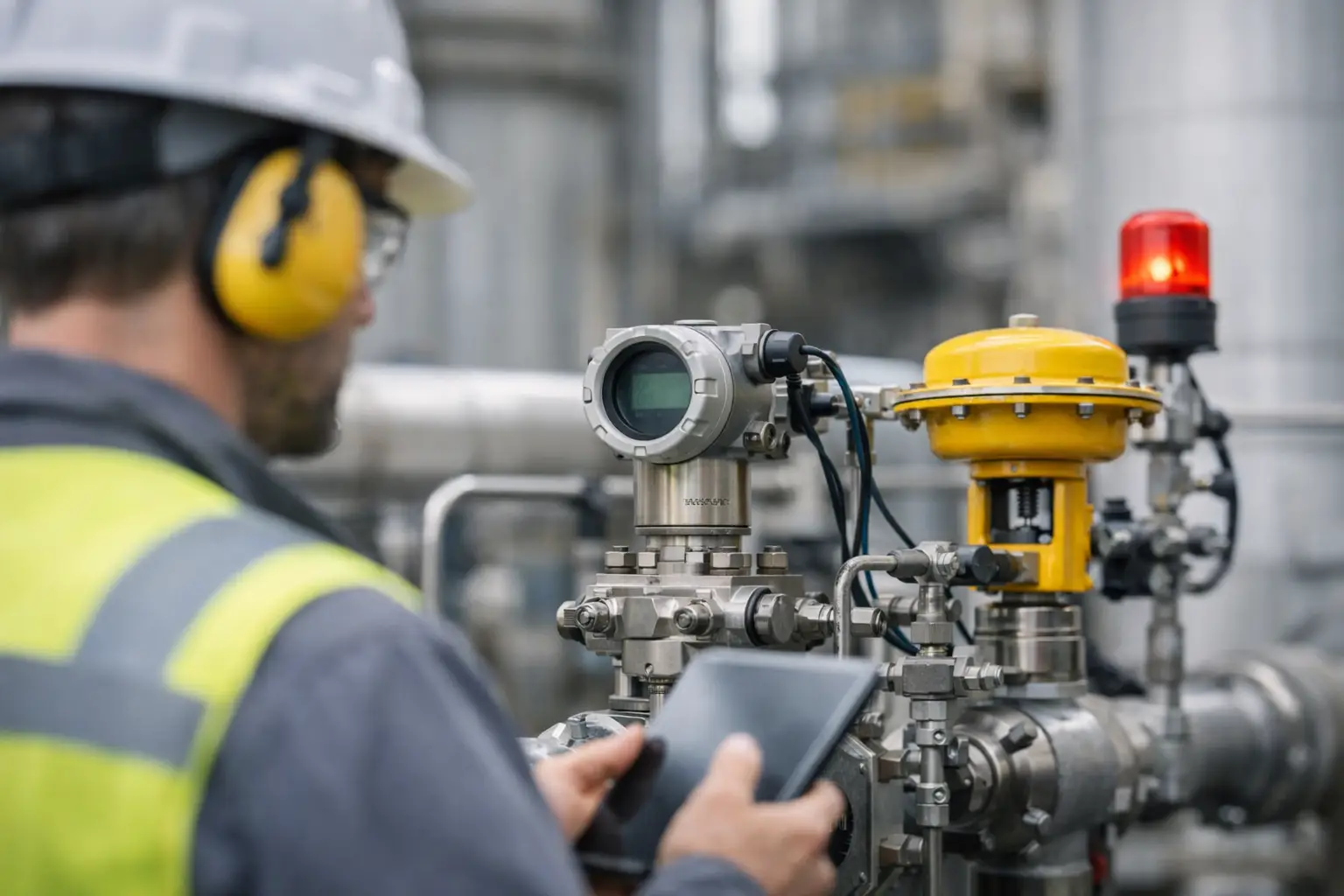
In practice, a SIF is usually defined by three parts. It has a sensor or sensors that detect the process condition, a logic solver that evaluates whether the trip condition exists, and a final element that places the process in a safe state.
Consider a simple example in a fired heater fuel gas train. If fuel gas pressure exceeds a setpoint that indicates an unsafe condition, a pressure transmitter sends that signal to the safety logic solver. If the logic confirms the trip condition, the system closes a shutdown valve and cuts fuel to the burner. That sequence is the SIF.
The key word is function. The engineering intent is not just to measure pressure or close a valve. It is to reduce risk from a specific hazard by performing a defined action within a required time and with a required reliability.
How a safety instrumented function differs from basic control
Many plants already have process control loops, alarms, interlocks, and operator procedures. Those are all useful layers of protection, but they do not automatically qualify as SIFs.
A SIF is designed and managed as an independent protection layer. It is separate in purpose from the basic process control system, even when the architecture is physically related. Under IEC 61511, that independence is central. The point is to ensure the protective function still works when the control layer fails, is bypassed, or is driving the process in the wrong direction.
For example, a standard PLC may stop a conveyor when a process limit is reached as part of normal sequencing. That is control logic. A safety PLC that trips equipment when a hazardous speed, pressure, temperature, or level condition creates unacceptable risk is performing a safety function. The hardware, software discipline, validation, and lifecycle requirements are different because the consequences are different.
This is also why alarm response alone is often not enough. If the scenario develops faster than an operator can see, decide, and act, the risk reduction from an alarm may be too low. In that case, the hazard study may show that an automatic SIF is required.
A safety instrumented function starts with hazard analysis
No credible SIF begins with hardware selection. It begins with risk.
Before a plant defines a SIF, the team needs to understand the hazardous event, the initiating causes, the existing layers of protection, and the consequence if those layers fail. Depending on the facility and process, this may come from HAZOP, LOPA, risk assessment, or another structured analysis method.
That work answers several critical questions. What exact condition must be detected? What is the safe state? How quickly must the action occur? How much risk reduction is required? What demand rate is expected? Without those answers, the SIF is just an interlock with unclear safety value.
This is where many projects go off track. Plants sometimes inherit trip logic over time and label it as SIS protection without a documented hazard basis, test interval, proof test coverage, or SIL target. That creates a false sense of security. If the function has never been tied back to a defined risk scenario and lifecycle documentation, it is hard to prove what protection it actually provides.
SIL and why it matters to a SIF
When people ask what is a safety instrumented function, the next question is usually about SIL. The two are connected, but they are not the same.
SIL, or Safety Integrity Level, is a measure of the risk reduction performance required from the SIF. In low-demand process applications under IEC 61511, the SIF is assigned a target SIL based on the gap between existing risk and tolerable risk. The design then has to show that the probability of failure on demand, architectural constraints, systematic capability, and lifecycle practices support that target.
A higher SIL does not automatically mean a better design. It means the scenario needs more dependable risk reduction. In some cases, that leads to redundancy, better diagnostics, more reliable final elements, or shorter proof test intervals. In other cases, the better decision is to reduce process risk upstream so the SIF does not need to carry so much burden.
This is one of the most important trade-offs in functional safety. A highly complex SIF may achieve the math on paper but become harder to maintain, test, and operate correctly. Good engineering balances reliability, maintainability, and real plant conditions.
What makes a SIF effective over time
A SIF is not effective because it was installed once. It is effective because it continues to perform as designed throughout its lifecycle.
That means the design basis must be documented, setpoints controlled, cause-and-effect clearly defined, and proof testing written in a way technicians can actually execute in the field. It also means accounting for bypass management, spurious trips, calibration practices, and management of change.
Final elements deserve particular attention. In many SIS applications, the weakest part of the function is not the transmitter or the logic solver. It is the valve, damper, contactor, or actuator that must physically change the process state when demanded. If that device is sticky, undersized, poorly maintained, or difficult to test, the whole SIF is compromised.
Response time is another issue that gets underestimated. It is not enough that the shutdown valve eventually closes. It has to close before the process crosses into an unsafe consequence. That timing should be validated, not assumed.
Common examples of safety instrumented functions
The exact application depends on the industry, but the pattern is consistent across chemical processing, food and beverage, oil and gas, water treatment, power, and general manufacturing.
A high-high level trip may stop inflow and close isolation valves to prevent vessel overfill. A high-pressure SIF may shut down a compressor and isolate suction or discharge paths. A high-temperature SIF may cut burner fuel. A low-flow SIF may protect rotating equipment from damage that could escalate into a release or fire scenario. On packaging or machine systems, a safety function may remove motion when a guard is opened or an unsafe position is detected, though machine safety frameworks often use different standards and terminology than process SIS.
The point is not the device count. The point is that each function has a defined hazard, a defined safe response, and a documented requirement for performance.
Why plants revisit SIFs during modernization
Many facilities are running aging controls, obsolete platforms, undocumented trip logic, and partial modifications accumulated over years of production pressure. That creates blind spots.
A modernization project is often the first time a plant asks whether existing shutdowns are truly safety instrumented functions, whether they still match the current process, and whether the proof testing and bypass practices can stand up to an audit or an incident review. Upgrades to PLCs, HMIs, and SCADA are a good opportunity to separate basic control from safety functions and rebuild documentation around IEC 61511 lifecycle expectations.
This is also where an engineering partner with both controls and safety experience adds value. If the team understands controls architecture but not functional safety, the design may be efficient yet noncompliant. If it understands standards but not plant operations, the result may be difficult to run and maintain. SIS Automations approaches this work as both a safety and implementation discipline, which is usually what plants need when the goal is reliable protection without adding unnecessary operational burden.
What is a safety instrumented function really for?
At its core, a safety instrumented function exists to do one job: reduce the chance that a known hazardous scenario turns into an injury, release, fire, explosion, or major equipment event. It is a defined engineered response to a defined risk.
That sounds straightforward, but good SIF design always lives in the details – process conditions, independence, diagnostics, testability, valve performance, operator workflow, and lifecycle management. If any of those are weak, the function may look compliant on paper and still underperform in service.
The best time to ask whether a SIF is correctly defined is before the next trip, bypass, startup, or audit forces the question. When the function is engineered clearly and maintained with discipline, safety stops being a patch on the system and becomes part of how the plant protects uptime, people, and assets every day.