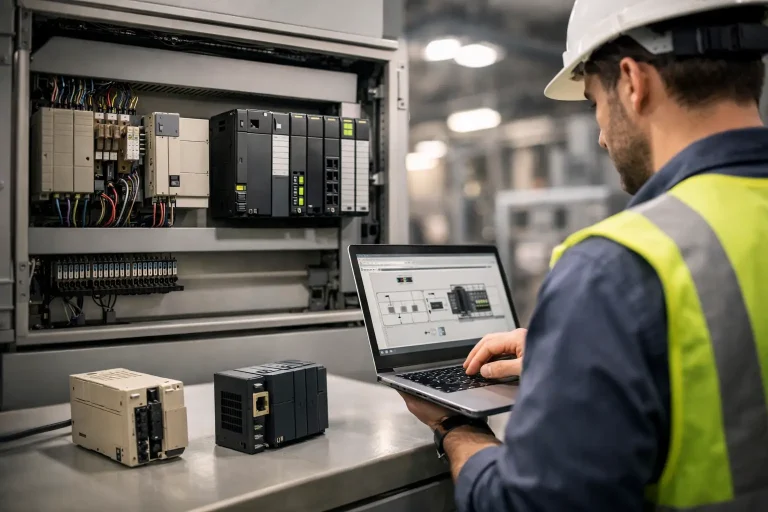
Manufacturing Traceability System Guide for Plants
When a quality hold is issued, the plant should be able to identify every affected lot, machine state, operator action, material source, and shipment path without assembling spreadsheets from three departments. That is the operating standard behind a manufacturing traceability system guide: create a reliable record of what happened, where it happened, and whether the process stayed within approved limits.
Thank you for reading this post, don't forget to subscribe!Traceability is not simply barcode scanning or database retention. It is an engineered information chain connecting materials, production events, quality decisions, equipment conditions, and finished goods. If that chain has gaps, a plant may still have data, but it cannot confidently prove product genealogy, isolate a containment area, or determine the source of recurring defects.
What a Manufacturing Traceability System Must Do
A traceability system should support both backward and forward genealogy. Backward traceability starts with a finished product or nonconforming lot and identifies the raw materials, subcomponents, process parameters, equipment, and inspections involved. Forward traceability starts with a suspect material or process event and identifies every work order, lot, pallet, customer order, or shipment affected.
The level of detail depends on the process and regulatory exposure. A discrete manufacturer may need serial-number-level tracking for safety-critical assemblies. A food, chemical, or pharmaceutical operation may require lot genealogy, time-based processing records, hold status, and documented electronic approvals. High-volume plants sometimes use batch or production-window traceability where unit-level serialization would create unnecessary cost and complexity.
The system must also distinguish between identity data and proof-of-process data. A lot number establishes what material was used. PLC and SCADA data can show whether the required temperature, torque, pressure, recipe, cure time, or test result was achieved. Both are necessary when the root cause may be process variation rather than the wrong material.
Define the Traceability Scope Before Selecting Technology
Many traceability projects fail because the team starts with software screens instead of defining the decisions the system must support. Begin with real operating scenarios: a supplier recall, a failed final inspection, a customer complaint, a mislabeled pallet, or an out-of-spec process alarm. For each scenario, determine the maximum acceptable time to identify affected inventory and the evidence needed to release or contain product.
A practical scope document should establish the traceability unit, the required genealogy relationships, critical process parameters, data-retention period, and responsible system of record. It should also define which transactions must stop production when they fail. For example, an unreadable component label on a medical or safety-related assembly may require an interlock or quality hold. A missing noncritical packaging scan may instead create an exception record for supervised disposition.
The design should answer four questions clearly:
- What item, lot, batch, or serial number is the traceability unit?
- Which material transformations, splits, merges, rework loops, and packaging steps must be recorded?
- Which process values and quality checks demonstrate conformance?
- Who can create, correct, approve, or release traceability records?
This work exposes trade-offs early. Capturing every available machine tag increases storage, validation effort, and troubleshooting noise. Capturing only final inspection data may leave the plant unable to explain why a defect occurred. The right scope concentrates on product-critical materials, parameters, and decisions.
Build the Data Chain From the Plant Floor Up
A useful architecture usually has several connected layers. At the machine level, PLCs acquire deterministic control signals, permissives, alarms, counters, and process values. HMIs provide operators with clear prompts for scans, recipe selection, material verification, and exception handling. SCADA or historian platforms collect time-stamped equipment and process records across the line.
Above the controls layer, a manufacturing execution system, quality application, or custom traceability database manages work orders, routing, genealogy, electronic records, and disposition status. ERP remains the financial and planning system of record for item masters, purchase orders, inventory, and customer orders. Warehouse systems may manage container, location, and shipment events.
The engineering challenge is not merely connecting these systems. It is preserving a consistent identity through each handoff. The work order, batch ID, container ID, material lot, machine cycle, and quality result need defined relationships. If one system calls a product an item number, another uses a SKU, and a third uses a legacy part code, the integration requires a governed mapping strategy rather than informal operator knowledge.
Time synchronization deserves the same discipline. PLCs, SCADA servers, operator terminals, vision systems, printers, and databases should use a common time source. Without aligned timestamps, reconstructing event order during an investigation becomes uncertain, especially where high-speed equipment, alarms, and operator interventions are involved.
Capture events at the point of work
Traceability records are most accurate when captured where the action occurs. Scan raw material when it is issued or consumed, not at the end of the shift. Associate a test result with the serial number automatically when possible, not through a manual transcription step. Capture process values directly from validated control tags rather than asking an operator to re-enter a displayed number.
Automation does not eliminate operator accountability. It reduces avoidable data-entry errors and makes exceptions visible. Effective HMI workflows guide the operator through the required sequence, reject invalid scans, display current material and work-order status, and document approved overrides. The screen design matters: a traceability prompt buried under multiple navigation layers will be bypassed under production pressure.
Design for Exceptions, Rework, and Real Plant Conditions
Normal production flow is easy to model. Real traceability performance is determined by how the system handles abnormal conditions. Material is moved to a different line, a label is damaged, a station is bypassed during maintenance, a batch is partially consumed, or product is reworked. Those events must be controlled rather than handled through handwritten notes and later reconciliation.
Rework deserves particular attention. The system should record the original product identity, reason for rework, disposition authority, materials removed or added, process route, and final quality release. If rework generates a new lot or serial identity, the relationship to the original record must remain visible. Otherwise, genealogy reports can falsely show a clean history.
Offline operation is another design decision. Plants with intermittent networks, mobile equipment, or remote process areas may need local data buffering and a defined reconciliation process. The goal is not to pretend connectivity never fails. It is to ensure that a communications outage does not force uncontrolled production or create duplicate transactions when systems reconnect.
Validate the System Against Operational and Compliance Risk
A traceability system is only as credible as its records. Validation should verify that the application captures required data, prevents unauthorized changes, identifies users where applicable, maintains audit trails, and produces accurate genealogy reports. In regulated environments, requirements may include electronic record and signature controls. In other plants, customer specifications, quality management procedures, or contractual recall obligations will drive the acceptance criteria.
Controls engineering is central here. If a process parameter is used as proof of conformance, confirm the signal source, scaling, alarm behavior, historian collection interval, and tag-quality handling. A value recorded during a sensor fault or communications loss should not be treated as valid process evidence. Similarly, recipe management should include version control, authorized change procedures, and confirmation that the active recipe matches the product being produced.
Functional safety records should remain appropriately separated from production genealogy while still supporting investigation. Safety PLC events, emergency-stop activations, bypasses, and alarm acknowledgments can provide valuable context after an incident or quality disruption. They should be collected and retained according to the plant’s safety lifecycle, cybersecurity, and records-management requirements.
Before go-live, test more than happy-path transactions. Run a mock recall from a finished shipment to incoming material. Start with a suspect supplier lot and trace forward through all affected inventory. Test a failed scan, duplicate serial number, rejected inspection, network interruption, rework order, and unauthorized recipe change. Measure the time required to generate a complete report, then compare it with the plant’s containment objective.
Implement in Phases Without Breaking Production
A phased rollout is usually lower risk than replacing every paper and legacy process at once. Start with a product family, line, or bottleneck area where defects, recalls, manual recordkeeping, or customer requirements create a clear business case. Establish baseline measures for recall response time, scrap, rework, first-pass yield, manual data-entry hours, and time spent searching for production records.
The first phase should prove the data model and operator workflow, not just demonstrate that systems can exchange messages. Once the plant confirms that genealogy is accurate and usable during a real shift, expand to adjacent processes. Standardize naming, scan formats, alarm handling, user roles, and commissioning documentation as the program grows.
Legacy modernization often requires a hybrid approach. An older PLC may not support modern communications or sufficient data buffering, but it can still provide critical signals through a gateway, SCADA interface, or targeted controls upgrade. The correct path depends on the equipment condition, cybersecurity requirements, expected service life, and cost of downtime. A lifecycle automation assessment can identify where limited integration is appropriate and where control-system replacement is the safer long-term decision.
A traceability program should give operations faster answers, not another dashboard to maintain. When the system is engineered around actual material flow, control logic, quality decisions, and exception handling, it becomes a practical tool for containment, root-cause analysis, compliance evidence, and more predictable production. The best next step is to test your current process with one question: if a critical lot were flagged this afternoon, how long would it take to know exactly what is affected?