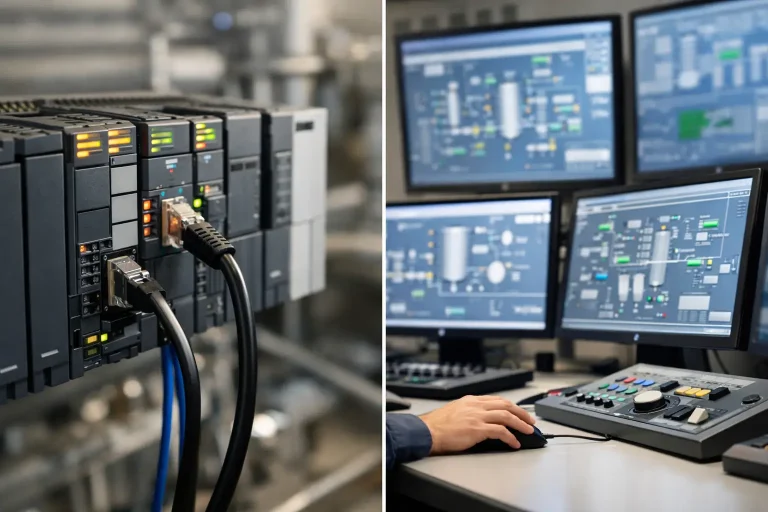
System Commissioning That Protects Plant Uptime
A new PLC program can compile correctly, a SCADA screen can look complete, and every panel can be energized – yet the process may still fail when production starts. System commissioning is the disciplined field process that proves the installed automation system performs as intended under actual operating conditions. It is where engineering assumptions meet field wiring, instrument behavior, operator workflows, process dynamics, and safety requirements.
Thank you for reading this post, don't forget to subscribe!For a manufacturing or process facility, commissioning is not a final checklist item. It is a controlled risk-reduction activity that protects startup schedules, product quality, equipment availability, and personnel. A rushed startup often moves unresolved problems into production, where a bad I/O map, improperly tuned loop, missed permissive, or untested emergency stop can become hours of downtime or a serious safety exposure.
What System Commissioning Must Prove
Commissioning confirms more than whether devices turn on. It verifies that the control system, field devices, machinery, safety functions, and operator interface work together according to the approved design basis.
At minimum, the commissioning effort should demonstrate that inputs are correctly identified and scaled; outputs drive the intended devices in the intended direction; alarms are prioritized and actionable; sequences respond correctly to normal and abnormal conditions; and operators can safely start, stop, hold, recover, and maintain the equipment. For integrated systems, this also includes communication between PLCs, variable frequency drives, robots, analyzers, historians, SCADA platforms, and third-party skids.
The standard of proof depends on the application. A simple conveyor addition may require focused I/O checkout and functional testing. A batch process, combustion system, or Safety Instrumented System requires a deeper validation plan, documented test evidence, defined acceptance criteria, and controlled handling of deficiencies. The correct scope depends on process hazard, production impact, regulatory obligations, and how extensively the system has changed.
Commissioning Starts Before Field Startup
The most expensive commissioning problems are usually created before anyone reaches the plant floor. Incomplete control narratives, ambiguous cause-and-effect diagrams, unreviewed P&IDs, inconsistent tag naming, and late design changes all create avoidable field rework.
A strong commissioning plan begins during design and programming. The team should establish the operating philosophy, control narratives, sequence descriptions, I/O list, alarm philosophy, interlock matrix, and test procedures before startup. These documents give operations, maintenance, engineering, and safety personnel a common reference for what the system is supposed to do.
Factory acceptance testing is often the first meaningful opportunity to find defects. FAT allows the project team to execute sequences, inspect HMI behavior, validate alarms, and challenge interlocks in a controlled environment. It cannot replace site testing because field devices, electrical installation, process conditions, and operator workflows are absent. It does, however, prevent basic programming and design defects from consuming valuable outage time.
For modernization projects, pre-startup planning matters even more. Existing drawings may not reflect field conditions, legacy PLC logic may contain undocumented workarounds, and replacement components may behave differently from the equipment they replace. A site survey, current-state controls audit, and backup strategy should be completed before cutover. The commissioning plan must include rollback criteria if the new system cannot be safely or reliably placed into service on schedule.
A Practical System Commissioning Sequence
The most reliable approach moves from individual components to complete operating scenarios. Skipping ahead to full automatic operation makes fault isolation slower because too many variables change at once.
Verify installation, power, and communications
Before functional tests begin, verify that panels, power distribution, grounding, network hardware, device addresses, and field terminations match approved documentation. Inspect labeling, enclosure condition, wire segregation, and instrument installation. Confirm that control power loss, communications loss, and device faults produce the expected diagnostic behavior.
This stage is where teams often uncover swapped conductors, incorrect analog signal types, unshielded communication cabling, duplicate IP addresses, reversed motor rotation, and mismatched field device ranges. Correcting these issues before sequence testing prevents false conclusions about PLC logic.
Perform I/O checkout and device validation
Each field input and output should be checked from the physical device through the controller and into the HMI or SCADA system. A high-level indication on a screen is not enough. The team must verify the actual instrument, wiring path, tag identity, engineering units, status indication, and failure response.
For analog devices, validate range, scaling, alarm setpoints, signal direction, and bad-value handling. For motors and valves, confirm command, feedback, permissives, fail position, local control interactions, and feedback timeout behavior. For variable frequency drives, confirm speed reference scaling, fault reporting, control source selection, and safe stop response.
Every discrepancy should be recorded with an owner, priority, corrective action, and retest requirement. Informal punch lists create risk because open items can be lost as startup pressure increases. A controlled deficiency process makes it clear which issues must be closed before operation and which can be managed after startup without compromising safety or production.
Test sequences, interlocks, alarms, and recovery
Once individual devices are proven, test the operating sequences that move product and control the process. Execute startup, normal run, controlled shutdown, manual operation, maintenance modes, equipment handoff, and restart after a fault. The objective is not merely to reach automatic mode. It is to prove the system behaves predictably when conditions are not ideal.
Interlock testing should challenge each permissive and trip condition. Confirm that the correct equipment stops, that the proper alarm is generated, and that the reset path requires the intended field condition and operator action. Nuisance trips should not simply be bypassed to meet a schedule. They require root-cause analysis, because repeated overrides train operators to distrust the safety and control system.
Alarm testing should evaluate more than annunciation. Operators need alarms that identify the condition, communicate priority, and support a practical response. Alarm floods during startup can conceal the one event that requires immediate action. Rationalized alarm priorities, suppression rules, deadbands, delays, and shelving controls help maintain situational awareness.
Validate safety functions separately
Safety functions require a separate level of discipline from standard controls testing. Emergency stops, safety gates, light curtains, safety PLC logic, relief actions, burner management trips, and other protective layers must be verified against the approved safety requirements and applicable standards.
For facilities operating under IEC 61511 or similar functional safety requirements, validation testing should confirm that each Safety Instrumented Function achieves the documented action under realistic conditions. This includes sensor response, logic solver behavior, final element action, bypass management, reset requirements, proof-test considerations, and test documentation. A safety function that exists only in a drawing or PLC comment is not a validated safeguard.
Independence also matters. When practical, personnel who were not solely responsible for developing the logic should participate in reviewing and witnessing critical safety tests. This improves objectivity and helps identify gaps created by familiarity with the design.
Startup Is a Performance Test, Not Just an Energization Event
A system can pass functional testing and still require optimization under production load. Process lag, material variation, utility pressure changes, operator timing, and upstream or downstream constraints become visible only when the plant is running.
This is the point to tune PID loops, verify production rates, assess reject handling, validate data collection, and confirm that OEE-related signals are accurate. It is also the time to watch for excessive cycling, unstable control, recurring communication faults, or operator workarounds. These are early indicators that the system may be functional but not yet maintainable or production-ready.
Acceptance criteria should be specific. Rather than declaring startup complete because equipment runs, define the expected throughput, control stability, alarm performance, quality result, reporting accuracy, and operator acceptance conditions. A documented performance test aligns the project team around measurable outcomes instead of subjective impressions.
Documentation and Training Keep the Result in Service
Commissioning value declines quickly if the plant is left with outdated drawings, unmarked logic changes, missing backups, or operators who do not understand the new sequence. The closeout package should include current electrical drawings, PLC and HMI source files, network architecture, I/O records, test results, alarm and setpoint records, open-item status, and backup instructions.
Training should be delivered in the context of real operating tasks. Operators need to understand normal operation, alarms, permitted overrides, and recovery actions. Maintenance personnel need diagnostics, manual control limits, device replacement steps, and backup restoration procedures. EHS and safety teams need evidence that safety functions were tested and that identified deficiencies were resolved or formally managed.
The best system commissioning effort leaves the facility with more than a working control system. It leaves a clearer operating baseline, stronger documentation, and a team that can recognize abnormal behavior before it becomes lost production or elevated risk.