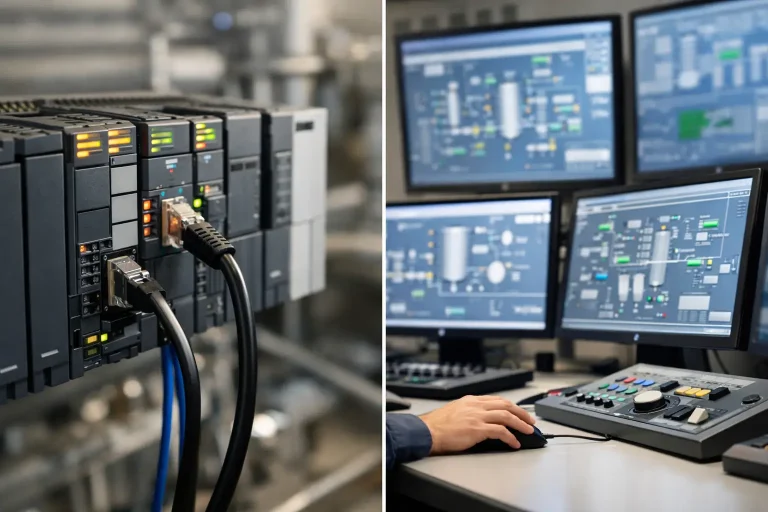
The Future of Functional Safety in Plants
A safety PLC installed fifteen years ago can still execute its logic correctly while the plant around it has changed completely. Networked assets, remote access, production data, staffing turnover, and aging field devices are changing the future of functional safety. For industrial operators, the question is not whether safety systems will become more connected and data-driven. It is whether that change will be governed with the same discipline applied to hazard analysis, proof testing, and safety lifecycle management.
Thank you for reading this post, don't forget to subscribe!Functional safety remains grounded in a simple operating requirement: when a defined hazardous condition occurs, the safety-related system must move the process or machine to a safe state with the required level of integrity. That requirement does not disappear because a facility adopts cloud analytics, machine vision, autonomous material handling, or artificial intelligence. It becomes more demanding because the controls architecture, interfaces, and potential failure modes expand.
The Future of Functional Safety Is Lifecycle-Driven
The most consequential change will not be a single new safety device. It will be broader recognition that functional safety is an operating discipline, not a design package completed at startup.
For process facilities, IEC 61511 establishes a lifecycle framework for safety instrumented systems, from hazard and risk assessment through decommissioning. IEC 61508 provides the underlying framework for electrical, electronic, and programmable electronic safety-related systems. Machine builders and manufacturers may also work within requirements such as ISO 13849, IEC 62061, NFPA 79, and applicable OSHA obligations. The standards differ by application, but the engineering principle is consistent: risk reduction must be specified, designed, verified, operated, tested, and managed through change.
Many plants have a gap between the original safety basis and current operations. A process may run at higher throughput. A machine may have received new guarding, drives, sensors, or operator stations. A control system may have been migrated without fully revisiting cause-and-effect documentation or safety requirement specifications. These changes can be justified and safe, but only when they are evaluated through formal management of change.
The future favors plants that treat functional safety documentation as a live engineering asset. Current P&IDs, loop drawings, safety narratives, logic diagrams, proof-test procedures, bypass records, and test results should align with the actual installation. When an incident, audit, trip investigation, or modernization project occurs, the plant should not have to reconstruct its safety design from archived PDFs and controller code.
Connected Safety Systems Will Improve Visibility, Not Replace Engineering
Connected safety systems can improve proof-test execution, demand-event reporting, diagnostic coverage, and visibility into bypasses or inhibited functions. A properly integrated SCADA or historian environment can show whether a safety instrumented function has been tested on schedule, how often a trip occurs, and whether a field device is producing recurring fault conditions.
That visibility has operational value. Repeated low-level trips may point to a degrading transmitter, poor process control, an improperly located sensor, or a setpoint issue. Frequent safety bypasses may reveal an underlying reliability problem or an operating procedure that no longer matches production reality. Alarm and event data can help engineering teams distinguish nuisance activity from credible process risk.
However, collecting more data does not automatically improve functional safety. A dashboard cannot establish a safety integrity level. Trend data cannot substitute for proof testing. Predictive models cannot validate a safety function unless their use, limits, failure behavior, and cybersecurity exposure have been explicitly assessed.
The right application of data is to support decisions made by competent personnel. For example, diagnostic data can help prioritize valve maintenance between scheduled proof tests, but it does not necessarily justify extending a proof-test interval. That decision depends on the safety requirement specification, failure-rate assumptions, test coverage, operating history, and the facility’s approved lifecycle process.
Cybersecurity Is Now Part of Safety Availability
As safety controllers, engineering workstations, remote support tools, and plant networks become more connected, cybersecurity and functional safety become operationally inseparable. A cyber event can impair the availability or integrity of a safety-related system. It can also create unsafe process conditions by disrupting basic process control, operator visibility, communications, or field instrumentation.
This does not mean every safety system should be isolated from all plant networks. It means connectivity must be intentional. Segmented network architecture, managed remote access, role-based permissions, secure backups, patch governance, asset inventory, and tested recovery procedures are now essential controls around the safety lifecycle.
A common modernization mistake is to focus on controller replacement while overlooking the engineering environment. If the only current safety program exists on an unsupported workstation, if source code backups are unverified, or if firmware revisions are undocumented, the plant has a lifecycle risk even when the process is running. A practical audit should examine the safety application, field devices, network paths, engineering tools, documentation, and recovery capability together.
Modernization Must Preserve the Safety Basis
Aging relays, legacy safety PLCs, obsolete I/O, and unsupported operator interfaces create legitimate reasons to modernize. The challenge is that migration work can introduce risk when teams treat safety logic as ordinary controls code.
Safety migrations require a clear baseline. Before converting logic, engineering should confirm the hazards addressed, initiating events, required safe states, trip setpoints, reset behavior, manual actions, response times, final elements, and proof-test requirements. The safety requirement specification should be specific enough that the new implementation can be independently verified.
This matters because logic translation alone can miss critical behavior. An old hardwired relay system may include de-energize-to-trip design, first-out indication, seal-in behavior, physical separation, or fail-safe wiring conventions that are not obvious in a software conversion. Likewise, replacing a controller may change scan times, diagnostic behavior, communication dependencies, or reset sequences.
A phased approach is often the best fit for operating plants. A facility may first inventory safety assets and resolve documentation gaps, then replace the highest-risk obsolete components during planned outages. Another site may need a full controls architecture redesign because unsupported hardware, poor panel condition, and production constraints make piecemeal work less defensible. The right path depends on process criticality, outage windows, spare-part exposure, and the quality of the existing safety basis.
Human Factors Will Remain a Deciding Factor
The best safety architecture still depends on how operators and maintenance teams interact with it. Poor HMI design, ambiguous alarms, unclear bypass controls, and complicated reset sequences can increase the likelihood of error during abnormal operations.
Future-ready functional safety design should make safety status understandable at the point of use. Operators need to know which function has tripped, what condition caused the trip, whether a bypass is active, and what actions are required before reset. Maintenance personnel need controlled access to diagnostics and test functions without creating informal workarounds that defeat safeguards.
Alarm management is closely connected to this issue. When alarm floods obscure the initiating condition of an upset, operators may respond late or act on the wrong signal. Rationalized alarms, clear priorities, effective suppression rules, and meaningful event sequences improve response quality while preserving the independence of the safety function.
Training also deserves more attention than it receives. Plants should not assume that a functional safety file is understood because it exists. Operations, maintenance, engineering, and EHS personnel each need role-appropriate knowledge of trips, interlocks, overrides, proof tests, and management-of-change requirements. This is particularly important as experienced personnel retire and responsibilities shift across teams.
What Plant Leaders Should Do Now
The immediate priority is not to purchase every new safety technology. It is to establish a reliable picture of current risk and system condition. Start with a lifecycle audit that compares the installed system against available documentation, safety requirements, test records, maintenance history, and current operating practices.
From there, prioritize issues that directly affect risk reduction and recoverability. Unsupported safety hardware, undocumented logic changes, overdue proof tests, failed final-element testing, uncontrolled bypasses, weak cybersecurity boundaries, and missing program backups should not wait for a broad digital transformation initiative.
For new projects, involve functional safety engineering early enough to influence the architecture. Safety functions, independent protection layers, network zones, control-panel design, HMI requirements, and commissioning tests are far less expensive to define before procurement and construction than to correct during startup. Factory acceptance testing, site acceptance testing, validation, and turnover documentation should be planned as part of project execution, not compressed into the final days before production.
The plants best positioned for the future will not be those with the most software screens or the newest controller family. They will be the facilities where safety requirements are clear, changes are controlled, proof testing is executable, and the installed system can be understood and recovered under pressure. That is the standard worth engineering toward before the next outage, expansion, or incident forces the issue.