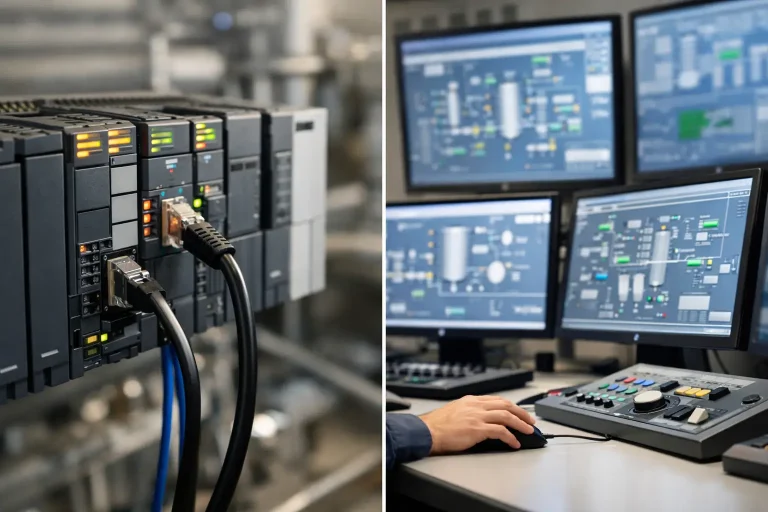
What Good Custom Control Panel Design Solves
A control panel usually gets attention only when something goes wrong – nuisance trips, overheating, intermittent I/O faults, or a technician wasting an hour tracing unlabeled wiring during a shutdown. That is why custom control panel design matters. In an industrial environment, the panel is not just an enclosure with components. It is the physical foundation of control reliability, safety compliance, maintainability, and future expansion.
Thank you for reading this post, don't forget to subscribe!Off-the-shelf panels can work for simple, repeatable applications. But many manufacturing and process operations are not simple or repeatable. They have unique motor loads, environmental conditions, network architecture requirements, safety circuits, operator interface needs, and plant standards. A panel that looks acceptable on paper can still create problems in the field if it was not engineered around the actual process and operating conditions.
Why custom control panel design affects plant performance
A well-designed panel supports more than basic machine operation. It influences startup time, troubleshooting speed, spare parts strategy, arc flash exposure, wiring quality, thermal performance, and how easily your team can modify the system later. When those factors are handled early, the panel becomes an asset. When they are ignored, the enclosure turns into a source of recurring downtime.
This is where custom engineering has real value. Proper component selection, load calculations, short-circuit current rating review, segregation of power and control, and network layout all affect long-term performance. So does the discipline behind documentation. Accurate schematics, terminal schedules, device labeling, and bill of materials structure matter just as much as the hardware itself when the system has to be maintained under production pressure.
For plants running aging equipment, custom design also creates a practical path for modernization. You may need to replace obsolete relays with a PLC-based architecture, add remote I/O, integrate VFDs, or migrate to a safety PLC while keeping part of the existing field wiring. That is not a catalog exercise. It requires engineering judgment, field awareness, and a clear understanding of what can stay, what should go, and what creates risk if left untouched.
What custom control panel design should account for
The right design starts with the process, not the enclosure size. Before hardware is selected, the engineering team should understand the machine or process sequence, required control philosophy, safety functions, operator interaction, utility conditions, and environmental exposure. A panel in a clean packaging area has different design constraints than one installed near washdown zones, corrosive chemicals, or heavy vibration.
Electrical loading is one of the first realities to address. Panels need correct feeder sizing, branch circuit protection, transformer sizing, power distribution, and thermal review. If you are adding VFDs, servo drives, process instrumentation, or high-density I/O, heat dissipation and internal spacing can become limiting factors quickly. A panel that is technically functional but thermally overloaded will fail in ways that are hard to diagnose and expensive to repeat.
Control architecture is just as important. The panel should reflect how the system will actually operate and be maintained. That includes PLC platform selection, network segmentation, managed versus unmanaged switching, remote access requirements, HMI integration, and provisions for data collection or SCADA connectivity. If future plant reporting, alarm management, or recipe handling is likely, those needs should influence the design now rather than force a costly retrofit later.
Safety must be engineered into the panel, not added after the fact. Depending on the application, that may include emergency stop circuits, safety relays, safety PLCs, guard interlocks, safety-rated motor control, and validation support tied to the required performance level or safety integrity target. Compliance considerations are not identical across facilities, and the exact requirements depend on the machine, process hazards, and site standards. Still, treating safety as a late-stage wiring task is one of the most common causes of redesign.
Custom control panel design and standards compliance
Compliance is where many projects become more complex than expected. Industrial panels are expected to align with applicable codes, panel construction practices, and site-specific requirements. That can include UL 508A considerations, NFPA 79 alignment for industrial machinery, NEC installation requirements, SCCR evaluation, and arc flash implications at the equipment level. In process facilities, the design may also need to account for hazardous area classifications, SIS interfaces, or documented safety instrumented functions.
The practical issue is that compliance is not just paperwork. It changes the physical design. It influences device selection, spacing, wire types, disconnect strategy, overcurrent protection, labeling, and documentation. It may also affect how the panel interfaces with upstream power distribution and downstream field devices.
For plant managers and EHS leaders, this is where a disciplined engineering process reduces risk. A panel can be built neatly and still fall short if the short-circuit rating is not coordinated with available fault current, if field modifications compromise the original design intent, or if the safety function was never validated against the actual machine hazards. Good engineering closes those gaps before startup.
Design choices that make maintenance easier
Maintenance teams feel the quality of a panel design long after startup is over. If terminal blocks are crowded, if wire numbers do not match the drawings, or if spare I/O was never considered, every service event takes longer than it should. That affects uptime directly.
Good panel design makes room for hands, tools, and future work. It includes logical device grouping, clean wire routing, consistent labeling, and terminal strategies that support isolation and testing. It also considers spare capacity. Extra I/O, panel space, network ports, and power margin may look like optional costs during procurement, but in many facilities they are cheaper than redesigning the enclosure a year later.
There is a balance to strike. Overbuilding every panel increases cost and footprint. Underbuilding creates operational friction and shortens the useful life of the system. The right answer depends on the criticality of the process, expected expansion, and the plant’s tolerance for downtime during future modifications.
When a standard panel is enough – and when it is not
Not every project needs a fully custom approach. If the application is low risk, functionally simple, and repeated across multiple identical assets, a standard panel design may be the right economic choice. This is especially true when plant standards are already established and the operating environment is controlled.
Custom control panel design becomes more valuable when the process is unique, when multiple systems must be integrated, when safety functions are significant, or when the panel has to fit into an existing operation with limited shutdown windows. It also makes sense when your facility is dealing with obsolescence, undocumented legacy controls, or recurring failures that point to a deeper design issue rather than a bad component.
That is often the difference between buying hardware and solving a plant problem. The enclosure is only one piece. The real deliverable is a control system that can be installed, started, maintained, and audited with confidence.
What to expect from an engineering-led panel project
The strongest projects usually begin with a design review that includes process requirements, I/O definition, power distribution, safety scope, communications architecture, and installation conditions. From there, engineering develops the schematics, panel layout, component selection, and documentation package with manufacturing and field service in mind.
Factory testing matters. Power-up checks, I/O verification, network validation, and functional testing catch issues before the panel reaches the floor. If the system includes PLC and HMI integration, testing should extend beyond panel wiring and into actual control behavior. That shortens commissioning and reduces surprises during startup.
Field support matters just as much. Even a well-built panel can underperform if installation practices, device termination, grounding, or startup sequencing are not controlled. This is why many industrial clients prefer a partner that can design the panel, support integration, and stay involved through commissioning. SIS Automations works in that full-lifecycle model because reliability is rarely won by design alone. It is achieved when engineering intent survives fabrication, installation, and startup.
A good panel should not need heroic troubleshooting to deliver basic performance. It should fit the process, meet the environment, support the operators, and give maintenance a fair chance to keep production moving. If your current controls are making simple work harder than it should be, the right custom design is often where the fix starts.